
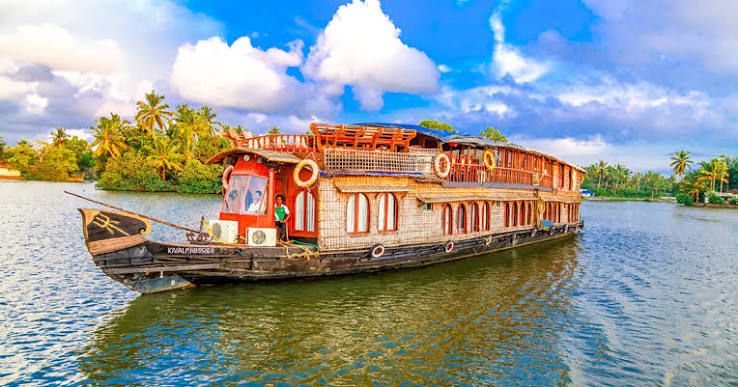
Most people view the Kerala backwaters from the deck of a houseboat. I wanted something less extravagant. On my second morning in Alappuzha, I walked to the boat terminal near the KSRTC bus stand where I joined a line of school children, office workers, and women who were carrying groceries. The boat belonged to the department of water transport of the state and was not at all a tourist boat. Hence, it ran on a fixed schedule.
The backwaters spread across Alappuzha, Kottayam and Kollam districts through a network of canals, lakes and rivers. Much of it sits below sea level, in a farming region called Kuttanad. Roads reach some of it, but boats still do most of the work.
Boarding a public ferry in the Kerala backwaters
The jetty was not easy to find. It is behind an old building on the highway, and I only found it by following a group of students. Tickets were bought at a small counter in no time. I sat at a place near a window and waited.
Passengers filled the lower deck first. Nobody seemed to be in a hurry. A man beside me folded his newspaper into a neat square before reading it, and two girls compared notes from a school exam. The engine started with a low rumble, and the boat pulled away from the bank.
Watching village life from the Kerala backwaters ferry
The trip to Kottayam goes through part of Vembanad Lake. It takes about two and a half to three hours. The timings differ, so you should check at the jetty on the day of travel.
The narrow canals gave the best views. Houses stood a few feet from the water, with steps leading down to the edge. Women washed clothes on the bank. A boy fed ducks from a small canoe. Fields lay below the level of the water, held back by earth bunds, which explained why every farm had its own channel.
At each small jetty, a handful of passengers stepped off and a few stepped on. The boat did not wait long. Locals boarded with ease, often without looking up, which told me how ordinary this journey was for them.
Learning the rhythm of the Kerala backwaters
After the second hour, I came to the realisation that I no longer felt the need for taking pictures and decided to simply watch. The boat set the pace. A conductor went through the deck, distributing tickets and answering questions in his mother tongue. When he saw that I was not local, he drew my attention to the church on the bank and a coconut processing yard half a mile away from the boat.
I could see the change in the scenery as soon as the narrow canals turned into larger water bodies. The weather felt refreshing on the lake, with fishing nets clearly visible due to their dark silhouettes against the blue sky and some fishing boats resting far away in the distance.
Practical notes for riding in the Kerala backwaters
It’s important to note that the boats are meant for commuting, so avoid peak hours if you want to get a seat on board. Early mornings and mid-morning times will have busy services near schools. Have some coins with you, keep your bag close to you, and prefer to stay on the shaded side of the boat.
People use this type of boat whenever they want to see the local sights without any hustle and bustle. There are some more advantages of using public boats, which need fewer resources than private cruises and help the local economy.
Where to stay near the Kerala backwaters
The city of Alappuzha serves as a good base for your trip, as the main jetty and bus station are located close to one another. When you look at hotels online, make sure to find a hotel that is nearby to the main jetty, as this will make your trip more convenient. In addition, the town of Kottayam offers various options if you are planning to return either by road or by train.
What the ferry showed me about the Kerala backwaters
As I left the boat, I could feel the sun shining on my skin. The journey was not thrilling since there were no attractions, no guides, and no visitor-centric program. However, it taught me something that a traveller needs to know.